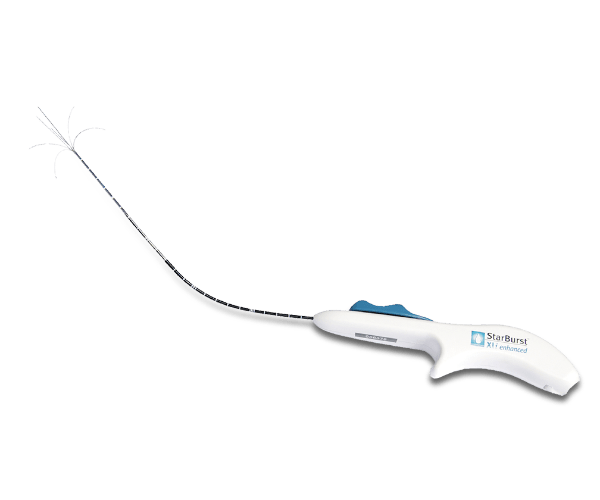
StarBurst® Xli-enhanced RFA Device
Scalability Means Flexibility
The "scalable" StarBurst Xli-enhanced radiofrequency ablation device is designed to create soft tissue ablation sizes of 4-7 cm with a single device placement. The device can be used for percutaneous, laparoscopic and intraoperative procedures.
Because Temperature Matters
The Xli-enhanced RFA device, with patented infusion-based technology, ensures consistent sustained target temperatures and enables the precise ablation of predictable volumes of tissue. The Starburst Xli-enhanced RFA Device reduces the time required to perform procedures and in many cases, enables patients to resume normal activity within days
StarBurst Xli-enhanced Semi-Flex RFA Device
Designed for Versatility
The Semi-Flex radiofrequency ablation device provides the same scalability and performance of its parent device, however, it Is designed with a trocar that bends in all directions up to 90 degrees to easily clear the CT gantry.

Important Risk Information
INDICATION FOR USE: The StarBurst Xli-enhanced Electrosurgical Device is a tool to transmit monopolar radiofrequency energy (provided by the Model 1500X RF Generator). It is indicated for use in percutaneous, laparoscopic, or intraoperative coagulation and ablation of soft tissue including the partial or complete ablation of non-resectable liver lesions and palliation of pain associated with metastatic lesions involving bone in patients who have failed or are not candidates for standard pain therapy. CAUTION: Federal (USA) law restricts these devices to sale by or on the order of a physician. CONTRAINDICATIONS: None known. WARNINGS AND PRECAUTIONS: For single use only. Do not bend or kink the trocar or the needles or exert forceful pressure on Device while it is deployed in the tissue; do not attach anything (i.e., clamps, etc.) to the Device, or use metal introducers that do not have insulation; inadvertent patient injury may result. To ensure safe and effective use follow the manufacturer’s directions and recommended practices for the preparation, placement, surveillance, removal and use of the dispersive electrode. To achieve the desired ablation follow the manufacturer’s guidelines of ablation time and temperature. Ensure that the device is placed at least 1 cm away from structures not intended for ablation. In laparoscopic procedures, care must be taken to avoid a gas embolism, and activation of the device when not in contact with target tissue may cause capacitive coupling. In some cases, a liver lesion will only be partially destroyed; the final determination of the success of lesion destruction can only be made by imaging studies following the procedure and during regular long-term follow-up. For ablation of painful bone metastases, do not perform RF ablation in weight-bearing bone with evidence of impending fracture. Pathologic fracture is more prevalent and serious in long bone. Please see package insert for complete list of warnings and precautions. POTENTIAL COMPLICATIONS: Published reports on the use of the RFA system indicate low overall complication rates. These include bleeding, abscesses and, in cases involving the treatment of bone tumors, fractures and nerve damage.
Indications, contraindications, warnings and instructions for use can be found in the instructions for use supplied with each device. Observe all instructions prior to use. Failure to do so may result in patient complications.